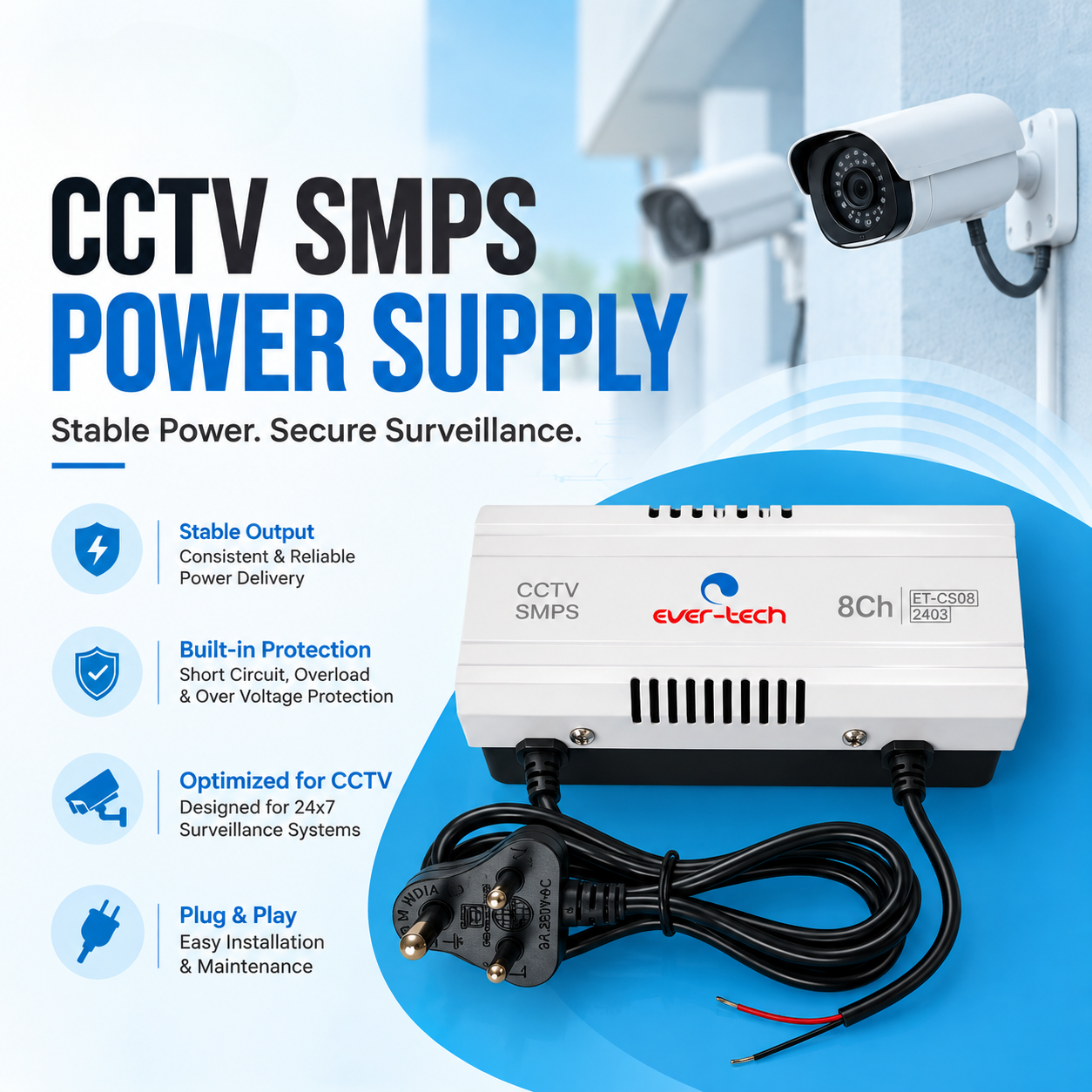
A reliable power supply is one of the most important parts of a CCTV security system. Even when you have good-quality cameras, DVRs, cables, and storage, an unsuitable or unstable CCTV power supply can affect camera performance and system reliability.
CCTV cameras require a consistent and appropriate power source to operate properly. Choosing the right power supply depends on factors such as the number of cameras, voltage requirements, total power consumption, and the type of CCTV system being installed.
In this guide, we explain what a CCTV power supply is, how it works, the different types available, and how to choose the right option for your security installation.
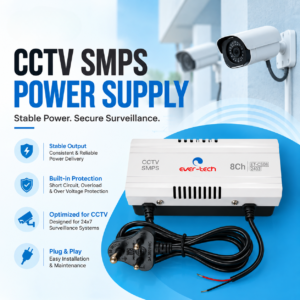
A CCTV power supply provides the electrical power required by security cameras and other surveillance equipment.
Most conventional CCTV cameras operate using a low-voltage DC power supply. A centralized CCTV power supply can distribute power to multiple cameras from a single location, helping keep the installation organized.
For example, instead of using a separate adapter for every camera, a centralized power supply can provide power to several cameras through individual output connections.
A typical setup can look like:
AC Power → CCTV Power Supply → CCTV Cameras
The exact voltage and power requirements depend on the camera models being used, so always check the manufacturer’s specifications before installation.
The power supply directly affects the stability of a CCTV system.
If cameras do not receive sufficient or stable power, you may experience issues such as:
This is why choosing a CCTV power supply should not be treated as an afterthought.
The power supply should be selected according to the number of cameras and their total power requirements.
There are two common approaches to powering CCTV cameras.
With individual adapters, each camera receives power from its own adapter.
This approach can be suitable for small installations where cameras are located close to convenient power outlets.
However, multiple adapters can result in:
A centralized power supply provides power to multiple cameras from one location.
This can be useful for larger CCTV installations because power distribution can be managed from a central point.
A centralized setup can make cable management and maintenance more convenient, particularly when several cameras are connected to the same surveillance system.
Many traditional CCTV cameras use 12V DC, but the exact requirement depends on the camera.
Before purchasing a power supply, check:
Never assume that every CCTV camera uses the same power specifications.
Using an unsuitable voltage can damage equipment or prevent the camera from operating correctly.
One of the most important steps when selecting a CCTV power supply is calculating the total power requirement.
Suppose you have:
8 cameras
and each camera requires:
12V, 1A
The theoretical maximum current requirement would be:
8 × 1A = 8A
The power requirement would be:
12V × 8A = 96W
However, it is generally better to avoid operating a power supply continuously at its absolute maximum capacity. Leaving appropriate headroom can provide additional capacity for variations in consumption and future requirements.
The actual calculation should always be based on the specifications of the cameras being installed.
This depends on the output capacity and design of the power supply.
CCTV power supplies are commonly available in configurations designed for different numbers of cameras.
For example, Ever-Tech offers CCTV power supply models for:
The appropriate model depends on the number of cameras and their power requirements.
However, the number of output connections alone is not enough to determine suitability. You should also check the total available power and the consumption of each connected camera.
Ever-Tech provides centralized CCTV power supply options for different installation sizes.
The ET-CS04 is designed for smaller CCTV installations where multiple cameras need to receive power from a centralized source.
It can be considered for installations requiring power distribution for up to four compatible cameras, subject to the cameras’ individual power requirements.
The ET-CS08 is designed for installations requiring centralized power distribution for up to eight compatible CCTV cameras.
It can be useful for small offices, shops, homes, and other surveillance installations where multiple cameras are installed.
The ET-CS16 is designed for larger CCTV installations requiring centralized power distribution for up to sixteen compatible cameras.
It can be suitable for larger surveillance setups where several cameras need to be powered from a centralized location.
Always verify the product’s electrical specifications and your cameras’ power requirements before installation.
Choosing between different channel configurations is relatively straightforward when the installation requirements are known.
CCTV Power Supply | Typical Application |
4-channel | Small CCTV installations |
8-channel | Small to medium CCTV systems |
16-channel | Larger CCTV installations |
However, the number of channels should not be the only consideration.
For example, an 8-channel power supply may have eight outputs, but the total available power still needs to be sufficient for the connected cameras.
Start by determining how many cameras need power.
If you have four cameras, a 4-output power supply may be suitable. If you have eight or sixteen cameras, consider a corresponding centralized power supply, provided the total power capacity is sufficient.
Check the required voltage of every camera.
The power supply voltage should match the requirements of the connected equipment.
Add the current requirements of all cameras.
For example:
Camera 1: 1A
Camera 2: 1A
Camera 3: 1A
Camera 4: 1A
Total theoretical requirement:
4A
The selected power supply should have sufficient capacity for the installation.
Power can be calculated using:
Power (W) = Voltage (V) × Current (A)
This helps you understand the overall electrical requirement of your CCTV system.
If you plan to add more cameras later, consider that when selecting your power supply.
A little additional capacity can make future expansion easier, provided the equipment is designed and rated for the intended load.
Consider where the power supply will be installed.
It should be installed in an appropriate, dry, ventilated location and protected from environmental conditions that could affect electrical equipment.
Power requirements can sometimes change depending on camera features.
For example, cameras using infrared LEDs for night vision may have different power consumption under certain operating conditions.
Therefore, when calculating power requirements, don’t look only at the camera’s basic daytime operation.
Check the manufacturer’s specified power consumption and consider the maximum expected load.
A CCTV system can experience power-related problems for several reasons.
If a camera repeatedly restarts, insufficient or unstable power can be one possible cause.
However, other factors such as cable problems, connectors, network issues, or camera faults can also produce similar symptoms.
This can sometimes occur when the camera’s power consumption increases when infrared illumination or other night-time features activate.
If the power supply does not have sufficient capacity, the camera may become unstable.
If several cameras connected to the same centralized supply stop working simultaneously, checking the power supply and its connections can be an important troubleshooting step.
Long cable runs can introduce voltage drop depending on the cable type, conductor size, current, and installation conditions.
For larger installations, cable selection and installation planning are therefore important parts of the power design.
CCTV systems can use different methods for providing power.
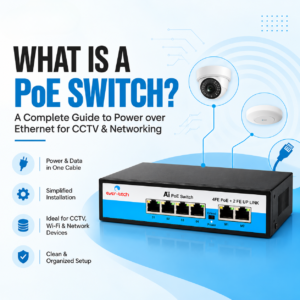
A traditional CCTV setup may use a centralized DC power supply, while IP cameras can often use Power over Ethernet (PoE).
Feature | CCTV Power Supply | PoE Switch |
Common camera type | Traditional CCTV cameras | IP cameras |
Power delivery | Dedicated power connection | Ethernet cable |
Network/data connection | Separate connection may be required | Data + power through Ethernet |
Typical application | Analog CCTV systems | IP CCTV systems |
Centralized power | Yes | Yes |
The right option depends on the type of camera and surveillance system being installed.
Follow these practices when setting up a CCTV power system:
Always match the power supply voltage to the camera requirements.
Do not exceed the rated capacity of the power supply.
Choose appropriate cables for the installation distance and expected load.
Loose connectors can cause intermittent power and camera problems.
Keep CCTV wiring organized and protected from unnecessary physical damage.
If future expansion is expected, consider the additional power requirements when designing the system.
A CCTV power supply provides electrical power to security cameras. It can be used as an individual adapter or as a centralized power source for multiple cameras.
Consider the number of cameras, required voltage, current consumption, total wattage, output configuration, cable distance, and future expansion requirements.
Yes. Centralized CCTV power supplies are designed to distribute power to multiple compatible cameras, provided the total power requirement stays within the supply’s rated capacity.
Many traditional CCTV cameras use 12V DC, but you should always verify the exact voltage requirement of your camera before connecting it to a power supply.
A CCTV adapter generally powers an individual device, while a centralized CCTV power supply can distribute power to multiple cameras from one location.
It depends on your camera system. PoE switches are commonly used with compatible IP cameras, while centralized DC power supplies are commonly used with traditional CCTV cameras. Check your camera specifications before choosing a power solution.
A reliable CCTV power supply is essential for maintaining a stable surveillance system. Selecting the right solution requires more than simply counting the number of camera connections.
Before purchasing, consider the camera voltage, current consumption, total power requirement, number of outputs, cable length, installation environment, and future expansion plans.
For smaller installations, a 4-channel solution may be appropriate, while larger systems may require 8-channel or 16-channel power distribution.
Ever-Tech offers CCTV power supply options including the ET-CS04, ET-CS08, and ET-CS16, giving installers and businesses different options for centralized CCTV power distribution.
By matching the power supply to the actual requirements of your cameras and installation, you can create a more reliable and organized CCTV system.

Excellence through technology
Excellence through technology

WhatsApp us